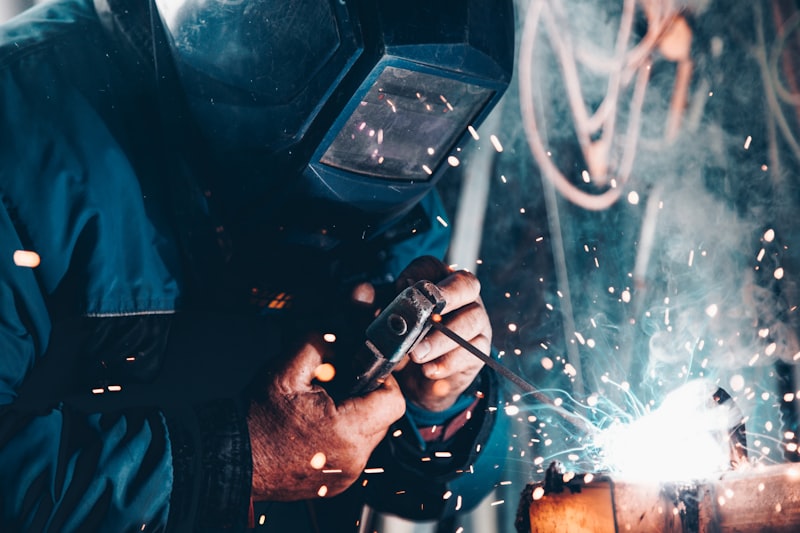
Key Engineering Highlights
- Automatic Submerged Arc Welding (SAW) produces high-deposition, defect-free longitudinal and circumferential pressure vessel joints.
- Gas Tungsten Arc Welding (TIG) ensures 100% root penetration and zero porosity on critical nozzle welds.
- Post-Weld Heat Treatment (PWHT) relieves internal residual stresses in heavy-wall carbon steel vessels.
- All welders are qualified and certified under ASME Boiler and Pressure Vessel Code Section IX.
The Foundation of Heavy Engineering: Weld Integrity
In industrial pressure vessel and chemical reactor manufacturing, the welded joint is the most critical juncture of structural containment. A single microscopic pore, slag trap, or lack-of-fusion defect can propagate into a stress crack under cyclic industrial pressures.
At Vishwakarma Engineering, we utilize advanced automated and semi-automated welding systems coupled with stringent ASME Section IX welder qualification standards to guarantee flawless weld seams.
Comparative Analysis of Core Welding Methodologies
| Welding Process | Primary Usage | Key Metallurgy Advantage |
|---|---|---|
| Submerged Arc Welding (SAW / 121) | Thick plate main shell longitudinal and circumferential seams | Submerged granular flux prevents oxidation; deep penetration with high impact toughness |
| TIG Welding (GTAW / 141) | Root runs, pipe-to-flange welds, thin-wall stainless steel vessels | Exceptional arc control, zero spatter, smooth hygienic root bead on internal product side |
| MIG/MAG Welding (GMAW / 131-135) | Fillet joints, external structural saddles, reinforcement pads | High deposition speed, strong structural fusion, minimal thermal distortion |
Thermal Controls & Post-Weld Heat Treatment (PWHT)
When welding heavy-thickness carbon steel (plates > 32mm) or specialized alloy steels, thermal gradients cause severe residual stress concentrations. We implement:
- Controlled Pre-Heating & Interpass Temperature Monitoring: Using calibrated digital contact pyrometers to prevent hydrogen-induced cold cracking in the Heat-Affected Zone (HAZ).
- Post-Weld Heat Treatment (PWHT): Controlled furnace heating and soaking according to ASME Section VIII UCS-56 cycles to restore ductility and relieve metallurgical stresses.
- Ferrite Number (FN) Verification: Ferrite scope testing on austenitic stainless steel welds to prevent hot cracking and ensure optimal corrosion resistance.
Why Trust Vishwakarma Engineering for Process Equipment?
ASME & IS Standard Compliance
Engineered to ASME Section VIII Div 1, IS 2825, and API 650 design rules.
100% Non-Destructive Testing
Hydrostatic testing, Radiography (RT), Ultrasonic (UT), and DPT checks.
State-of-the-Art Machine Shop
CNC plate rolling, dish end spinning, and automated SAW welding towers.
Global Exporter Capabilities
Seaworthy packaging, nitrogen purging, and TUV/SGS third-party dossiers.
Frequently Asked Questions
Vishwakarma Engineering Metallurgy Division
Vishwakarma Engineering is an ISO-certified heavy fabrication facility based in Ahmedabad, Gujarat, specializing in high-pressure vessels, chemical reactors, storage tanks, and ETP equipment.
Ready to Discuss Your Custom Fabrication Project?
Share your design specifications or process datasheets with our senior engineering team for an accurate quotation and technical review.
+91 99240 12425 Request Technical Quote