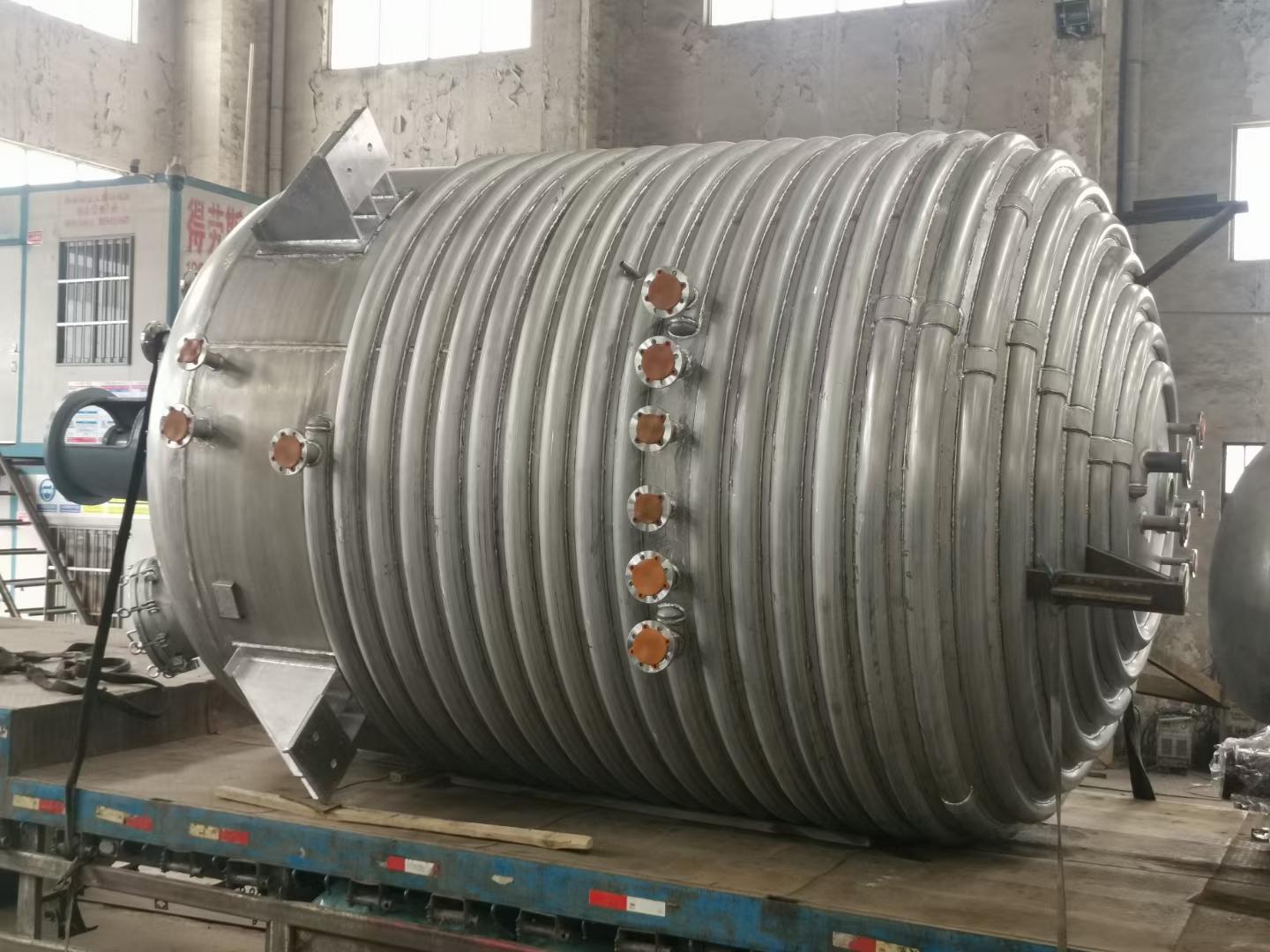
Key Engineering Highlights
- Limpet half-pipe coils create high-velocity forced circulation, doubling heat transfer rates compared to stagnant conventional jackets.
- Withstands utility pressures up to 25 Bar, preventing vessel collapse under high thermic fluid or steam loads.
- Zoned multi-pass coil designs enable simultaneous or staged heating and rapid water quenching.
- Precision fillet welding with complete NDT dye penetrant and hydro testing ensures zero pinhole leaks.
The Physics of Half-Pipe Limpet Coil Heat Transfer
In chemical synthesis plants across Gujarat, such as pigment manufacturing, resin synthesis, and pharmaceutical bulk drug plants, controlling chemical reaction temperature is paramount. Limpet coil reactor vessels (half-pipe coil jackets) are the industry standard for handling high-pressure heating and cooling utilities.
Unlike conventional double-wall jackets where fluid can channel or bypass, a limpet coil half-pipe forces the thermal fluid through a continuous, defined helical path. This creates high Reynolds number turbulent flow, significantly improving the overall heat transfer coefficient (U-value).
Engineering Design: Split Pipe vs. Formed Channel Limpets
At Vishwakarma Engineering, our limpet coils are rolled from split seamless pipe or cold-formed heavy-gauge strips in SS 304, SS 316, or Carbon Steel:
- Half-Pipe Coil Geometry: Semi-circular 180° cross-section provides high hoop strength against internal utility pressure while minimizing thermal expansion stresses on the shell.
- Multi-Start Helical Coils: For large reactor vessels (above 5,000 Liters), multi-start parallel limpet circuits reduce overall pressure drop across the circulation pump.
- Bottom Dish End Limpet: Specialized spiral dished coils welded to the bottom torispherical head ensure heat transfer coverage across 95%+ of the liquid batch volume.
Welding Integrity & Hydraulic Certification
Welding hundreds of meters of limpet coil onto a pressure vessel requires meticulous thermal balancing to avoid vessel cylinder distortion:
- Continuous GTAW / TIG root welding followed by MIG fill passes for maximum fatigue strength under thermal cycling.
- 100% Liquid Dye Penetrant Testing (DPT) on both coil fillet legs before insulation cladding.
- Sequential Hydrostatic Testing: Vessel shell hydro tested at 1.5x MAWP, followed by independent limpet coil hydro testing at 1.5x utility pressure.
Why Trust Vishwakarma Engineering for Process Equipment?
ASME & IS Standard Compliance
Engineered to ASME Section VIII Div 1, IS 2825, and API 650 design rules.
100% Non-Destructive Testing
Hydrostatic testing, Radiography (RT), Ultrasonic (UT), and DPT checks.
State-of-the-Art Machine Shop
CNC plate rolling, dish end spinning, and automated SAW welding towers.
Global Exporter Capabilities
Seaworthy packaging, nitrogen purging, and TUV/SGS third-party dossiers.
Frequently Asked Questions
Vishwakarma Engineering Heat Transfer Group
Vishwakarma Engineering is an ISO-certified heavy fabrication facility based in Ahmedabad, Gujarat, specializing in high-pressure vessels, chemical reactors, storage tanks, and ETP equipment.
Ready to Discuss Your Custom Fabrication Project?
Share your design specifications or process datasheets with our senior engineering team for an accurate quotation and technical review.
+91 99240 12425 Request Technical Quote