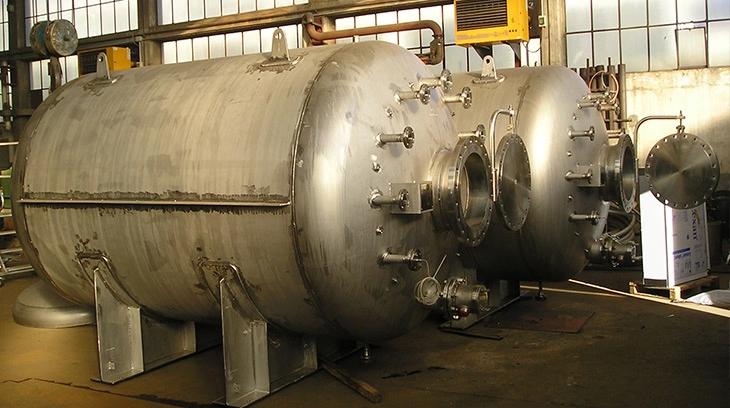
Key Engineering Highlights
- Strict compliance with API 650 structural calculations prevents tank wall buckling and foundation settlement.
- Ultrasonic thickness gauging (UTG) identifies hidden bottom plate thinning and internal acid etching.
- Pressure-vacuum safety vents and flame arrestors protect against tank implosion and vapor flashovers.
- Secondary containment bund walls ensure environmental safety in the event of unforeseen spills.
The Imperative of Storage Tank Safety in Chemical Plants
Large-capacity atmospheric storage tanks hold millions of liters of volatile solvents, acids, fuels, and hazardous intermediate chemicals. Because these vessels operate continuously for decades under variable weather conditions and aggressive internal chemicals, proactive safety engineering is essential to avoid catastrophic structural failure.
At Vishwakarma Engineering, safety is engineered into every tank we manufacture through strict compliance with API 650, API 620, and IS 803 design rules.
Essential Safety Features for High-Risk Chemical Tanks
Modern storage tanks require integrated mechanical and instrumentation safeguards:
- Breather Valves & Emergency Relief Vents: Dual-action pressure-vacuum valves (PVV) prevent tank rupture during thermal expansion and vacuum collapse during rapid pump-out.
- Deflagration & Detonation Flame Arrestors: Installed on vent outlets to prevent external sparks or lightning strikes from igniting internal flammable vapors.
- Corrosion Allowance & Material Margin: Engineering an extra 1.5mm to 3.0mm wall thickness cushion based on specific chemical corrosion rates.
- High-Level Radar & Independent Overflow Alarms: Automated level transmitters paired with pneumatic shut-off valves prevent overfilling disasters.
Preventative Inspection Protocols (API 653)
Periodic non-destructive examination maintains tank integrity throughout its operating life:
- Ultrasonic Thickness Gauging (UTG): Systematic thickness profiling of bottom plates, shell courses, and roof sheets.
- Magnetic Flux Leakage (MFL) Floor Scanning: Detects underside soil-side corrosion on tank bottom plates without destroying the floor.
- Vacuum Box Testing: Tests 100% of bottom plate lap welds for micro-porosity using soapy solution and calibrated vacuum chambers.
Why Trust Vishwakarma Engineering for Process Equipment?
ASME & IS Standard Compliance
Engineered to ASME Section VIII Div 1, IS 2825, and API 650 design rules.
100% Non-Destructive Testing
Hydrostatic testing, Radiography (RT), Ultrasonic (UT), and DPT checks.
State-of-the-Art Machine Shop
CNC plate rolling, dish end spinning, and automated SAW welding towers.
Global Exporter Capabilities
Seaworthy packaging, nitrogen purging, and TUV/SGS third-party dossiers.
Frequently Asked Questions
Vishwakarma Engineering Safety & Quality Cell
Vishwakarma Engineering is an ISO-certified heavy fabrication facility based in Ahmedabad, Gujarat, specializing in high-pressure vessels, chemical reactors, storage tanks, and ETP equipment.
Ready to Discuss Your Custom Fabrication Project?
Share your design specifications or process datasheets with our senior engineering team for an accurate quotation and technical review.
+91 99240 12425 Request Technical Quote