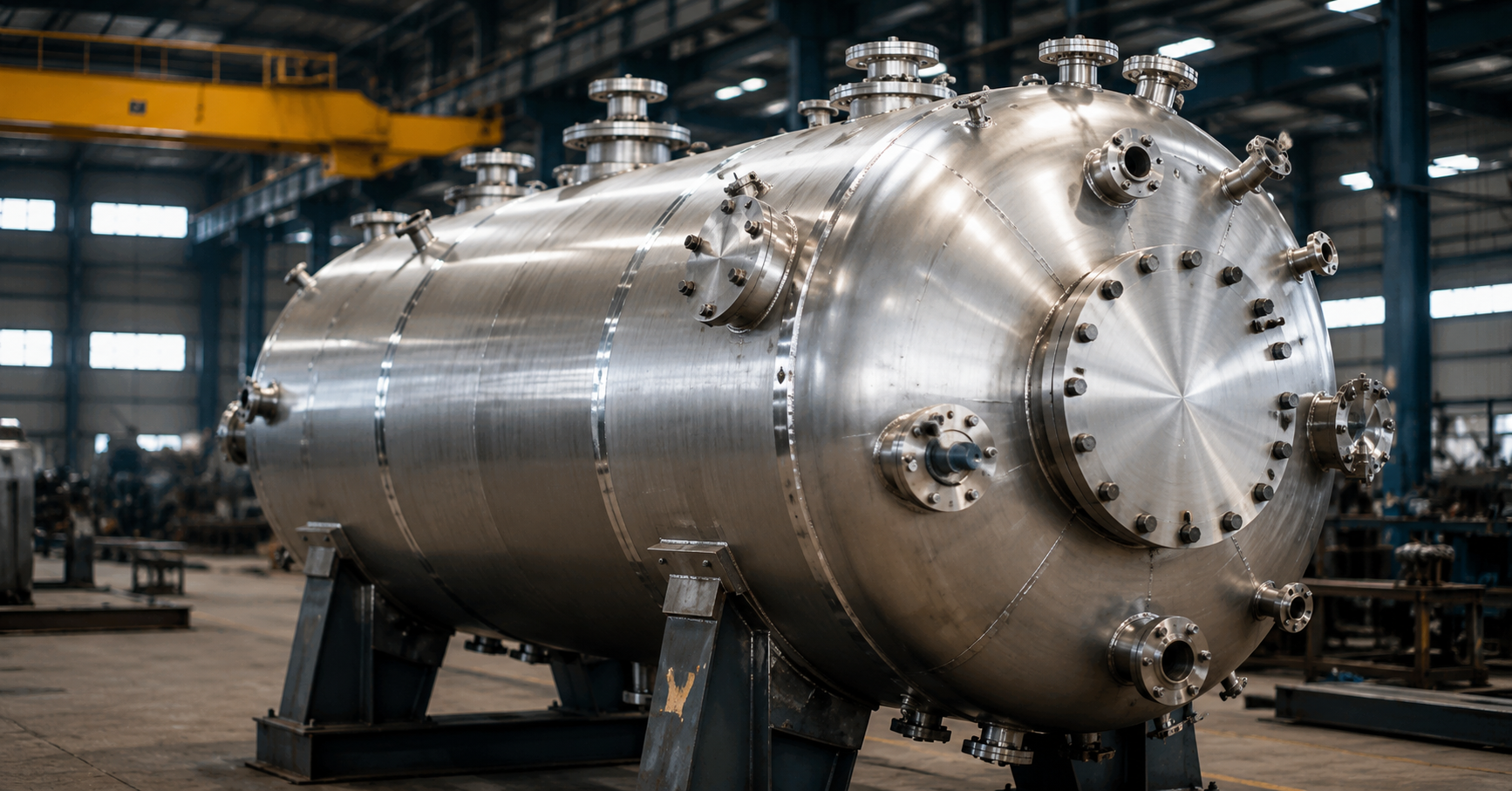
Key Engineering Highlights
- Adherence to ASME Section VIII Div 1 and IS 2825 design codes ensures operational safety under extreme pressures.
- Plate preparation, CNC cutting, and precision hydraulic rolling form the dimensional baseline.
- Automatic Submerged Arc Welding (SAW) and 100% Non-Destructive Testing (NDT) eliminate seam defects.
- Rigorous 1.5x hydrostatic pressure testing verifies structural integrity before plant commissioning.
Introduction to Industrial Pressure Vessel Manufacturing
In modern chemical, petrochemical, oil & gas, and pharmaceutical processing industries, industrial pressure vessels are critical containment units that store fluids, vapors, and gases at pressures significantly exceeding atmospheric levels. Because sudden failure can result in catastrophic downtime or safety hazards, the pressure vessel manufacturing process demands exact mathematical calculations, certified metallurgy, and uncompromising quality inspection protocols.
At Vishwakarma Engineering in Ahmedabad, Gujarat, we engineer and fabricate custom industrial pressure vessels in compliance with global standards including ASME Boiler & Pressure Vessel Code (Section VIII Division 1) and IS 2825. Here is an inside look at each technical phase of our precision manufacturing process.
Stage 1: Material Selection & Metallurgical Testing
The integrity of a high-pressure tank begins with raw material verification. We source certified plates directly from prime steel producers accompanied by Mill Test Certificates (MTC 3.1/3.2).
- Boiler Quality Carbon Steel: SA 516 Gr. 70, SA 516 Gr. 60 for high-tensile, moderate-to-low temperature services.
- Austenitic Stainless Steel: SS 304, SS 304L, SS 316, SS 316L, and SS 316Ti for corrosive chemical storage and sanitary pharma applications.
- Duplex & Alloy Steels: 2205 Duplex and Hastelloy for severe acid and saline environments.
Incoming plates undergo positive material identification (PMI), ultrasonic laminations scanning, and tensile impact testing before being cleared for the shop floor.
Stage 2: Precision Cutting, Edge Beveling & CNC Plate Rolling
To achieve clean weld penetration, plates are cut using CNC high-definition plasma or submerged waterjet machines. The plate edges are precisely prepared with V-grooves, U-grooves, or double-bevel configurations.
Next, the plates pass through hydraulic 4-roll CNC plate bending machines. Pre-pinching ensures minimal flat ends, achieving near-zero ovality and uniform shell cylinder roundness across diameters ranging from 500 mm up to 4,500 mm.
Stage 3: Advanced Automated Welding Processes
Welding constitutes the structural core of any pressure vessel. Our shop employs qualified welding procedure specifications (WPS) and procedure qualification records (PQR):
| Welding Technique | Application Area | Key Advantages |
|---|---|---|
| Submerged Arc Welding (SAW) | Longitudinal & circumferential shell seam joints | Deep penetration, uniform bead, zero spatter, exceptional weld strength |
| Gas Tungsten Arc Welding (TIG / GTAW) | Root pass on stainless steel pipes, nozzles & flanges | Highest purity, crevice-free root penetration, zero slag |
| Gas Metal Arc Welding (MIG / GMAW) | Structural attachments, saddles & lifting lugs | High deposition rate, strong structural bonding |
Stage 4: Dish End Forming & Assembly
Pressure vessel heads (dish ends) are manufactured in Torispherical, 2:1 Semi-Ellipsoidal, or Hemispherical geometries depending on the operational design pressure. Crown-and-petal or single-piece hydraulic dishing and spinning techniques guarantee consistent wall thickness throughout the knuckle radius. The shells and dish ends are then aligned with laser leveling systems on motorized rotator rollers.
Stage 5: Non-Destructive Testing (NDT) & Hydrostatic Proof Test
Before any vessel leaves our Ahmedabad facility, it undergoes multi-tiered quality testing:
- 100% Radiographic Testing (RT) / Ultrasonic Testing (UT): Scans all butt weld joints for internal porosity, slag inclusion, or lack of fusion.
- Liquid Dye Penetrant Testing (DPT) & Magnetic Particle Testing (MPT): Inspects nozzle weld attachments and structural welds for surface micro-cracks.
- Hydrostatic Pressure Testing: The vessel is filled with treated water and pressurized to 1.5 times the maximum allowable working pressure (MAWP) with calibrated digital gauges, holding pressure under third-party inspection (TUV, Bureau Veritas, SGS, DNV).
- Surface Finishing & Passivation: Pickling and chemical passivation for stainless steel vessels; grit blasting (SA 2.5) followed by epoxy/polyurethane marine coating for carbon steel tanks.
Why Trust Vishwakarma Engineering for Process Equipment?
ASME & IS Standard Compliance
Engineered to ASME Section VIII Div 1, IS 2825, and API 650 design rules.
100% Non-Destructive Testing
Hydrostatic testing, Radiography (RT), Ultrasonic (UT), and DPT checks.
State-of-the-Art Machine Shop
CNC plate rolling, dish end spinning, and automated SAW welding towers.
Global Exporter Capabilities
Seaworthy packaging, nitrogen purging, and TUV/SGS third-party dossiers.
Frequently Asked Questions
Vishwakarma Engineering Technical Team
Vishwakarma Engineering is an ISO-certified heavy fabrication facility based in Ahmedabad, Gujarat, specializing in high-pressure vessels, chemical reactors, storage tanks, and ETP equipment.
Ready to Discuss Your Custom Fabrication Project?
Share your design specifications or process datasheets with our senior engineering team for an accurate quotation and technical review.
+91 99240 12425 Request Technical Quote